
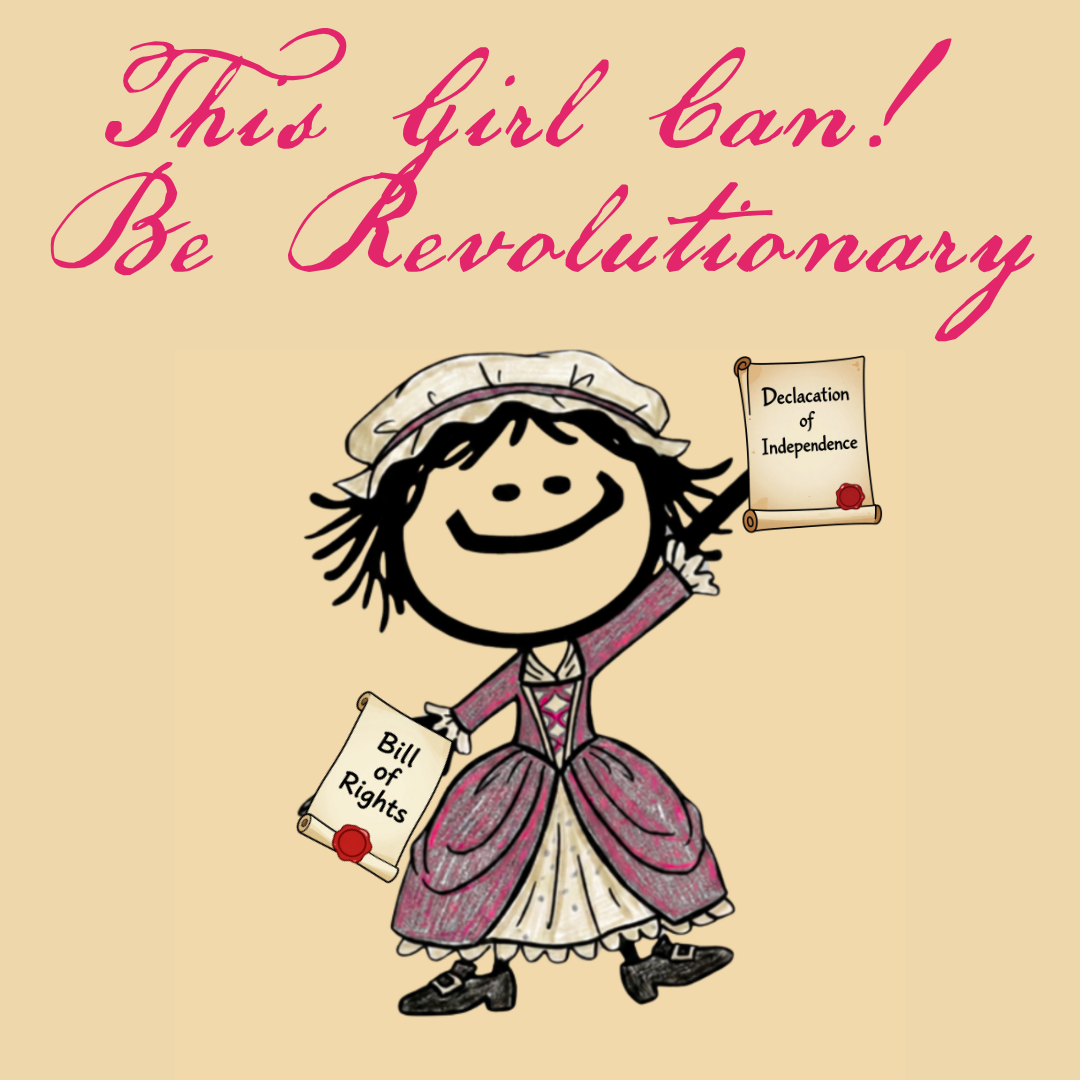
This Girl Can! Be Revolutionary
As America celebrates its 250th year, who do you think of when you reflect on this nation’s founding? Whose stories do you know, and which figures from history come to mind?
Most of us think of John Trumbull’s iconic painting and see all the “guys” at the signing of the Declaration of Independence. Or we remember seeing Emmanuel Leutze’s Painting of ‘Washington Crossing the Delaware’ in our history books. There, of course, are the Battles of Lexington and Concord and the “shot heard round the world” in 1775, the Battle of Saratoga in 1777 and the Battle of Yorktown in 1781 which forced the British to surrender.
But, where were the women during all this time of strife, protest, contentious debates, and war? If we are to just look at traditional resources and textbooks, we would think that women had no role in the founding of this country.
250 years later it is time to fix that perception!
Take for example, Margaret Cochran Corbin, the first woman to receive a military pension. When her husband John went to war, she went with him. Many women during the war became “camp followers”, doing laundry, cooking and tending to the wounded. Margaret, however, put herself literally in the line of fire. In 1776, when her husband went to fight in the Battle of Fort Washington, Margaret dressed as a man and followed him into battle, helping to load his cannon. When he was fatally wounded, Margaret stepped up and fired the cannon herself. She, too, was hit and was unable to use her left arm for the rest of her life.
In 1782, Deborah Sampson asked the question,
"Why can I not fight for my country, too?"
She disguised herself as a man named Robert Shurtleff and joined the Fourth Massachusetts Regiment. For over two years, her real identity went undetected. She received a gash in her forehead from a sword and was shot in her thigh, and extracted the bullet herself. She was the only woman to receive a full military pension from the United States government.
There was nothing prudent about Prudence Cummings Wright. With all the men off in battle, Prue would lead an armed militia to defend the town’s covered bridge to stop the smuggling of information North to Canada. The women of her militia captured the spies as they were crossing the bridge, taking their documents and holding them prisoner, preventing the British from knowing the plans of American troops.
Perhaps one of the few women who comes to mind when we think about this time in history would be Betsy Ross. Betsy may be best known for showing George Washington how to make a five-pointed star and sewing the first American flag, but she was also a businesswoman, having taken over her late husband’s upholstery business and worked on uniforms, tents, and flags for the Continental Army.
Yes, women were running things in 1776! In fact, if you have a really close look at the bottom of the Declaration of Independence, you will see this
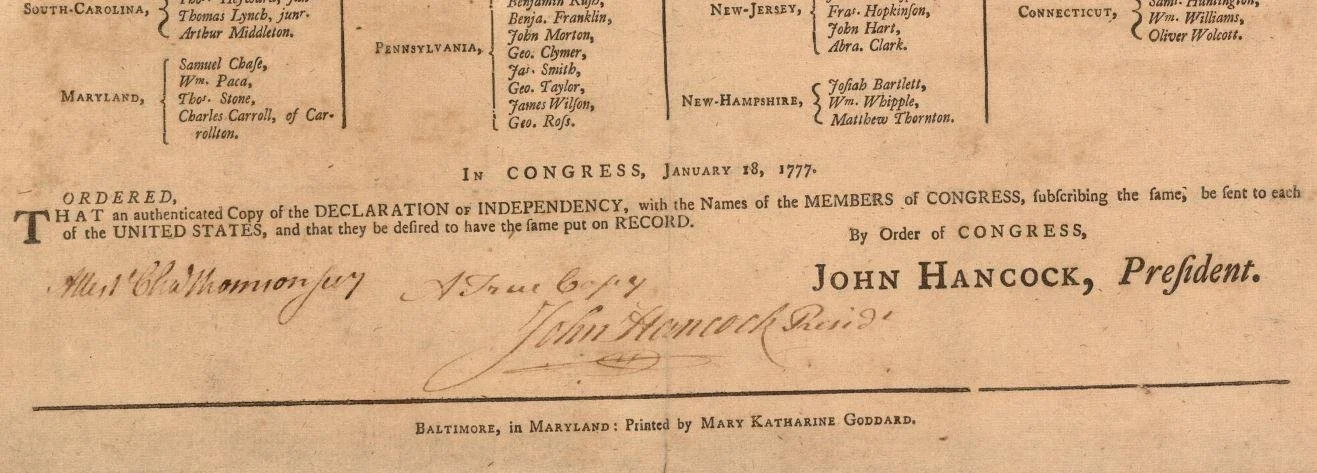
While it may not be a signature, the name of Mary Katharine Goddard is the only woman’s name to appear on the document. Mary Katharine owned a printing business in Baltimore, Maryland, and she ran the Baltimore post office, a bookstore, and also published a newspaper, the Maryland Journal, which advocated for patriotic causes. She published Thomas Paine’s ‘Common Sense’ and was the first printer to publish the Declaration of Independence in its entirety, displaying all the signers’ names. She boldly made the decision to include her own name at the bottom, sort of a de facto signer of the Declaration, and potentially put herself at risk for treason charges.
Women’s voices in 1776 and throughout the Revolution were NOT silent.
Mercy Otis Warren was a playwright, satirist and historian, known for her writings in support of the revolutionary cause and featuring strong women’s voices. She was an outspoken critic of the British rule and wrote plays and poems in support of the American ideals of freedom and independence. She believed in the idea of “Republican Motherhood” encouraging women to be active politically as mothers to model good citizenship for their children. An advocate for women’s education, she wrote a history of the American Revolution that included the contributions of women. Mery believed that women should freely express ideas about politics and government, despite the fact they would have no rights or vote in that government until 1920. After the war, she was critical of the way the new government was forming, with too much Federal power, she often published her political writings under a pen name, and criticizing the new Constitution and calling for individual rights and liberties to be included. Her widely-distributed pamphletswere influential in the formation of The Bill of Rights.
Phillis Wheatley was an enslaved poet and the first African American poet, and only the second woman, to have her work published. In July 1761, at the age of 6 or 7, she was kidnapped from her home in West Africa and sent to Boston on a slave ship. A Boston merchant, John Wheatley, and his wife Susanna, purchased her and named her after the ship she arrived on, Phillis. She received a highly unusual education for any girl, let alone an enslaved girl. A strong and vocal supporter of the Revolution, she would write a poem dedicated to George Washington and spoke of her own enslavement. It would be the written word that Phillis used to call for freedom and speak out against slavery. Her eventual fame gained her own emancipation in 1773. Despite knowing there was little hope of men like Washington, who praised her work, changing the circumstances of slavery, she would continue to support the Revolution and use her pen to be heard.
“Any time while I was a slave, if one minute’s freedom had been offered to me, and I had been told I must die at the end of that minute, I would have taken it—just to stand one minute on God’s earth a free woman—I would.”
~ Elizabeth Freeman
Elizabeth Freeman(“Mum Bett”) was also enslaved in Massachusetts for over 30 years. Her “mistress’ often was violent with her and in an incident where she struck her sister with a heated kitchen shovel, Elizabeth protected her sister by blocking the strike, resulting in a serious wound on her arm that would never heal. Rather than cover her arm, she left the scar visible as evidence of her mistreatment. In the increasingly abolitionist-leaning Massachusetts, this reflected poorly on the Ashleys, and the injury impeded her ability to work, all enraging her enslaver more.
When she overheard a discussion by her enslaver, Colonel Ashley, of the ‘Sheffield Declaration’, she began to question why the words “…mankind in a state of nature are equal, free, and independent of each other, and have a right to the undisturbed enjoyment of their lives, their liberty and property.”did not and could not apply to her. She sought the help of Theodore Sedgwick, a lawyer and Massachusetts delegate to the Continental Congress, who had helped to draft the Sheffield Declaration. Sedgwick, saw the case as a potential “test” to determine if slavery was constitutional under the new Massachusetts Constitution. In August of 1781, the case went to the County Court of Common Pleas of Great Barrington Massachusetts in the case known as Brom and Bett v. Ashley. Sedgwick would argue that the Massachusetts Constitution, with its language of “all men are born free and equal” set the ground for outlawing slavery. The jury agreed that Bett and Brom were not Colonel Ashley's property. While she never learned to read or write, she would change the world! helping to set a legal precedent for abolishing slavery in the Commonwealth of Massachusetts in 1783. Upon winning her freedom, she chose a new name, Elizabeth Freeman. She would go on to be a healer and work for the Sedgwicks. After 20 years, she was able to buy her own land for $75, which had a small house and barn where she lived the rest of her life, a free woman.
“I wish most sincerely there was not a Slave in the province. It always appeared a most iniquitous Scheme to me—fight ourselves for what we are daily robbing and plundering from those who have as good a right to freedom as we have. You know my mind upon this Subject.”
~Abigail Adams to her husband John
And of course, there was Abigail Smith Adams, who, while known as the second First Lady of the country and the Mother of the sixth President, was in so many ways the voice of conscience for her husband John Adams while he worked to form a new nation. Growing up, Abigail did not have a formal education as schools were exclusively for the education of boys, leaving girls with the most basic of education, helping them to be a “lady in society”. This did not sit well with Abigail. Growing up, she had a liberal father and an encouraging family. With access to a large library, she would read everything she could get her hands on and would be a staunch advocate to ensure girls had access to books and formal education. She would write to her husband,
“If you complain of neglect of Education in sons, What shall I say with regard to daughters, who every day experience the want of it....If we mean to have Heroes, Statesmen and Philosophers, we should have learned women. The world perhaps would laugh at me, and accuse me of vanity, but you I know, have a mind too enlarged and liberal to disregard the Sentiment. If much depends, as is allowed, upon the early Education of youth and the first principles which are instilled take the deepest root, great benefit must arise from literary accomplishments in women.”
In 1764, Abigail married an ambitious lawyer John Adams. Their marriage was a partnership, and though her husband John was not known to be publicly a fan of women’s rights, Abigail’s counsel throughout their marriage and numerous long separations influenced the thinking and the principles of a new nation. Famously, when he was in Philadelphia, she would stridently write to him to impress upon him that the new nation was not for men alone.
“I long to hear that you have declared an independency -- and by the way in the new Code of Laws which I suppose it will be necessary for you to make I desire you would Remember the Ladies, and be more generous and favourable to them than your ancestors. Do not put such unlimited power into the hands of the Husbands. Remember all Men would be tyrants if they could. If particular care and attention is not paid to the Ladies, we are determined to foment a Rebellion, and will not hold ourselves bound by any Laws in which we have no voice, or Representation.”
Abigail Adams would argue to her husband that women simply would not follow laws in which they were not represented. Though her own marriage was far more equal than most of the day, she understood that every woman’s right to “life, liberty, and the pursuit of happiness”, could never be relied upon to happen by the grace of her husband. Under the laws of coverture, married women did not exist under the law, with no right to own property or money. Abigail was concerned with greater protection for women under the new laws, as well as access to formal education for girls and women. She, too, like her friend Mercy Otis Warren, was a proponent of “Republican Motherhood”, believing that mothers had a vital role to play in political life and must be involved in politics to prepare their sons (and daughters) to be citizens and leaders.
Abigail was a woman in charge, she had to be. Her husband was gone for years at a time, so it was left to her to run their farm, deal with the Revolution literally at her doorstep, protect her children, engage in commerce, buy property and she would see four of her six children die.
Abigail’s lifelong influence on not only her husband but also a burgeoning nation was profound. John Adams needed her. He wrote after his election as President in 1797, “I never wanted your Advice and assistance more in my life…” Abigail was not a demure First Lady. She did not sit back. She would fervently defend her husband and his positions. She, in fact, became the “go-to” for many who wanted access to her husband. She would famously “plant” positive stories in the press about John. Some of her husband’s critics and the press believed Abigail was so instrumental in her husband’s work that she was called “Mrs. President.
Throughout her life, Abigail Adams was a voice to be reckoned with, despite a social, political, and legal culture that denied women their rights; hers was a voice that would not be silenced.
And so, while we see and learn about and reference the “Founding Fathers”, Abigail, and we, would remind us all to “Remember the Ladies”.
250 years later, we need to ensure that the women who were essential not only to the formation of a new nation, but to the running of life and home and the pursuits of free speech and liberty should never be ignored. As the National Women’s History Museum reminds us *She is NOT a Footnote! Because This Girl Can! Make HERstory.
Only by paying “particular care and attention” to telling their stories, teaching their history, and celebrating their legacies can we move forward to fulfill the promises of that preamble to the Declaration so that it is a common assumption that “all people are created equal and are endowed with certain unalienable Rights, that among these are Life, Liberty and the pursuit of Happiness.”